
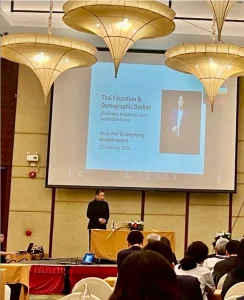
Event: 6th International Conference on Education
Organised by: Association of Private Higher Education Institutes of Thailand (APHEIT) under Royal Patronage of HRH Princess Maha Chakri Sirindhorn
Speaker: Assoc. Prof. Dr. Jomphong Mongkhonvanit, Vice President and Dean, Graduate School of Business, Siam University
Date: Sunday, 22 February 2026
Category: News / Higher Education Policy, Demographic Crisis & Institutional Adaptation
Overview
Assoc. Prof. Dr. Jomphong Mongkhonvanit delivered the Opening Keynote Address at the 6th International Conference on Education, organised by the Association of Private Higher Education Institutes of Thailand (APHEIT) under the Royal Patronage of HRH Princess Maha Chakri Sirindhorn. His address — titled “Thai Education & Demographic Decline: Challenges, Adaptation, and a Sustainable Future” — placed one of the most urgent and underaddressed challenges facing Thailand’s education sector squarely at the centre of the sector’s flagship annual gathering.
About APHEIT and Its Royal Patronage
The Association of Private Higher Education Institutes of Thailand (APHEIT), established in 1979, is the representative body for Thailand’s private universities and higher education institutions — encompassing more than 65 member institutions across the country. Operating under the Royal Patronage of HRH Princess Maha Chakri Sirindhorn, APHEIT brings together the leadership of Thailand’s private higher education sector to address shared challenges, advance academic quality, and develop collective policy positions.
The APHEIT International Conference on Education is the association’s premier academic platform — a forum where private institution leaders, educators, researchers, and policy advocates engage with the most pressing questions facing higher education in Thailand and the region. Dr. Jomphong’s selection as Opening Keynote speaker signals the significance and urgency of the demographic challenge he addressed.
The Crisis: Thailand’s Demographic Decline and Its Implications for Education
Thailand is facing one of the most severe demographic transitions of any country in the world. The numbers are unambiguous:
- Thailand’s Total Fertility Rate (TFR) has fallen to approximately 1.2 children per woman — far below the replacement level of 2.1, and among the lowest in Southeast Asia
- Thailand’s birth rate has declined by over 80% in the past 74 years — a trajectory that places it third globally (after South Korea and China) in terms of the speed and scale of fertility decline
- Without policy intervention, Thailand’s population could shrink from approximately 70 million to as few as 30–33 million within 60 years — a reduction of more than 50%
- The college-aged population (18–22 years) is projected to have already shrunk significantly over the past decade, with higher education enrollments declining by approximately 9% between 2012 and 2016 alone — a trend that has accelerated since
For Thailand’s private higher education sector, these demographics are not an abstract future threat. They are a present operational reality. Private institutions — which depend primarily on tuition revenue and are less insulated than public universities — are already contending with falling student numbers, closure pressures, and the need for fundamental institutional reinvention.
The Keynote: Three Dimensions of the Crisis
Dr. Jomphong’s address — framed around Challenges, Adaptation, and a Sustainable Future — provided the assembled leaders of Thailand’s private higher education sector with both a clear-eyed diagnosis of the problem and a framework for responding:
Challenges
- The structural mismatch between an education system designed for population growth and the reality of a shrinking, ageing student cohort
- The fiscal pressures on private institutions as tuition revenue bases contract
- The quality and skills dimensions of demographic decline: fewer students and a more complex student profile, requiring more individualised, flexible, and technology-enabled pedagogy
- The international competitiveness dimension: Thailand risks losing its educated young people to emigration while simultaneously producing fewer graduates overall
Adaptation
- Institutional portfolio diversification — moving beyond traditional degree programmes to lifelong learning, professional development, and upskilling for the ageing workforce
- Digital and AI-integrated delivery — reaching learners who cannot access traditional campus-based education
- International student recruitment — compensating for declining domestic cohorts by attracting learners from across ASEAN and beyond
- Industry partnerships and work-integrated learning — ensuring that smaller graduate cohorts deliver higher-quality human capital to the labour market
A Sustainable Future
- The demographic challenge, while severe, is not without precedent or solution. Countries including Japan, South Korea, Singapore, and several European nations have navigated similar transitions — and their experiences offer both cautionary lessons and actionable models
- For Thai private higher education, sustainability requires honest reckoning with which institutions can survive, which must transform, and which might productively merge or specialise
- The role of the state — in providing policy frameworks, financial incentives, and regulatory flexibility — is critical to enabling the sector to adapt at the speed the demographic reality demands
Why This Keynote Matters
Speaking to the leadership of Thailand’s private higher education sector on demographic decline is not a comfortable assignment. It asks institutional leaders to confront existential pressures directly, in a professional setting, on the occasion of their premier annual conference.
Dr. Jomphong’s willingness to take on this topic as an Opening Keynote — and his capacity to offer not just a diagnosis but a framework for adaptation — reflects both his deep engagement with Thailand’s education challenges and the trust the private higher education community places in his analytical and institutional authority.
For the 65+ member institutions of APHEIT and their leadership teams, the keynote served as both a call to realism and a call to action: the future of Thai private higher education depends on institutions that adapt with clarity, creativity, and courage — and the communities they serve deserve leaders who will help them do so.
Key Takeaways
- Thailand’s demographic decline is no longer a distant projection — it is an active force reshaping student numbers, institutional finances, and the strategic options available to private higher education institutions right now
- Dr. Jomphong’s Opening Keynote at the APHEIT 6th International Conference positioned demographic adaptation as the defining strategic challenge for Thailand’s private higher education sector in 2026 and beyond
- The three-part framework — Challenges, Adaptation, and Sustainable Future — offered a clear and actionable structure for institutional leaders navigating an unprecedented transition
- Private higher education institutions that diversify, digitalise, internationalise, and deepen industry partnerships will be best positioned to serve Thailand’s learners sustainably in a demographically contracted market
- APHEIT’s decision to open its 6th International Conference with this keynote reflects the association’s commitment to honest, evidence-based leadership — and to preparing its member institutions for the realities ahead
6th International Conference on Education, organised by the Association of Private Higher Education Institutes of Thailand (APHEIT) under Royal Patronage of HRH Princess Maha Chakri Sirindhorn. Opening Keynote by Assoc. Prof. Dr. Jomphong Mongkhonvanit, 22 February 2026.