
Published 26 May 2026 • Source: IIEP-UNESCO
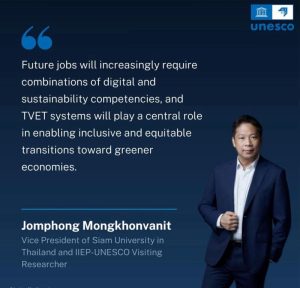
As the world of work keeps evolving, technical and vocational education and training (TVET) systems are shifting their focus toward lifelong adaptation. In a new interview with IIEP-UNESCO, Jomphong Mongkhonvanit, Vice President of Siam University in Thailand and an IIEP-UNESCO Visiting Researcher, explains how education systems can weave foundational, digital, and green skills together to meet fast-changing labour market demands.
According to the researcher, the value of TVET now extends well beyond training a person for a single occupation. The priority, he argues, is to develop adaptable learners who can continuously reskill, manage uncertainty, and keep learning across shifting career pathways. That ambition places TVET at the centre of broader education-system transformation and national development planning, rather than treating it as a stand-alone workforce mechanism.
Beyond technical training
A recurring theme in the research is the growing importance of foundational and transversal competencies alongside technical know-how. Skills such as problem-solving, communication, digital literacy, ethical reasoning, socio-emotional ability, and adaptability are increasingly prized by employers as labour markets become more dynamic and technology-driven. The work also stresses the need to view the green and digital transitions together rather than in isolation, since many future jobs will demand a combination of sustainability and digital competencies.
Planning that keeps pace with the labour market
Drawing on exchanges with IIEP specialists, the researcher highlights governance, financing, quality assurance, institutional capacity, and policy implementation as the factors that often decide whether reforms succeed in practice. A central message is the importance of closing the gap between long-term educational planning and rapidly evolving labour market demands, particularly in areas shaped by artificial intelligence, digitalization, and the green transition. Linking skills development to wider societal goals — equity, sustainability, resilience, and social inclusion — is presented as equally essential.
Looking toward 2030
The research aims to help countries build more integrated, future-oriented, and resilient TVET systems aligned with the Sustainable Development Goals, notably SDG targets 4.3, 4.4, and 4.7. It seeks to show policymakers and institutions how foundational, digital, and green skills can be embedded systematically into curriculum design, teacher development, qualifications frameworks, and lifelong learning systems, while strengthening international cooperation across ASEAN and the Global South. The ultimate goal, the researcher notes, is TVET that is not only more responsive to labour market needs but also more inclusive and human-centred.
A closer look at Thailand
Thailand’s formal TVET system serves close to 915,000 students across three qualification levels: a three-year secondary vocational degree, a two-year higher vocational diploma, and a two-year bachelor-level vocational diploma. While these pathways are crucial for building a skilled workforce, weak foundational skills constrain their capacity to deliver on national development goals. The research frames foundational skills as a prerequisite for benefiting from vocational training and for acquiring digital and green skills later on, and argues that the main challenge is not a lack of standards or frameworks but the difficulty of turning policy intent into consistent delivery across institutions.
Key recommendations from the research include:
- Measure foundational skills and monitor progress within TVET.
- Strengthen diagnostics and remediation capacity in formal TVET.
- Build teacher development and institutional support for teaching foundational skills.
- Expand applied learning as a vehicle for practising foundational skills.
- Reduce regional disparities by improving learning conditions and infrastructure.
- Reinforce learner support and persistence, including financial support for students.
- Improve access, recognition, and quality in non-formal and workplace pathways.
Source: IIEP-UNESCO — “How TVET can prepare learners for a changing world of work”