
Destination: Shanghai and Ningbo, China
Programme: Faculty and Staff Retreat — “The Rise of Humanoid AI”
Key Visit: Joyson Group Headquarters & Humanoid Robotics Factory, Ningbo
Institutional Visit: Ningbo City College of Vocational Technology (宁波城市职业技术学院)
Institution: Siam Technology College (SiamTech) / Siam University
Category: News / Innovation Immersion, Faculty Development & International Academic Partnership
Overview
Siam Technology College (SiamTech) took its faculty and staff on an exceptional professional development retreat to Shanghai and Ningbo, China — a trip designed not simply for relaxation or cultural enrichment, but for an immersive encounter with one of the most consequential technological developments of our era: the rise of humanoid artificial intelligence.
Led by Dr. Jomphong Mongkhonvanit, the delegation visited cutting-edge robotics facilities, engaged with Chinese vocational technology institutions, and returned with a visceral, first-hand understanding of the technological transformation that will reshape industries, education, and workforce needs in the years ahead.
Joyson Group: Witnessing Humanoid Robots at Scale
The centrepiece of the retreat was a visit to Joyson Group’s headquarters and humanoid robotics production facility in Ningbo — one of China’s most significant industrial clusters for what is being called the country’s next strategic industry: embodied intelligent robotics.
Joyson Group — a Ningbo-based conglomerate with a long history in automotive safety and electronics — has made a bold strategic pivot into humanoid robots. The SiamTech delegation encountered the company’s flagship humanoid robot: J.A.R.V.I.S. (Joyson A Robot Vibrant Intelligent System), version 2.0.
J.A.R.V.I.S. is not a concept prototype. It is already operational in real industrial environments, performing repetitive tasks in car factories. With 12 degrees of freedom in its hands, LiDAR, advanced binocular vision sensors, and a flexible LCD screen that displays facial expressions, J.A.R.V.I.S. is capable of reliably performing the equivalent workload of eight people. The robot has also been equipped with olfactory sensors capable of identifying 60 different scents — a capability with wide applications in quality control, safety monitoring, and consumer service environments.
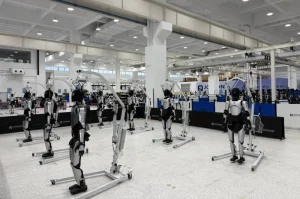
The factory floor — visible in the delegation’s photographs — revealed rows of humanoid robot frames in various stages of development: a striking tableau of the future of manufacturing, assembled in the present tense.
The Humanoid Robot Market: A Strategic Horizon
The visit came at a critical inflection point for the industry. Global market projections estimate the humanoid robot sector could reach USD 154 billion by 2035, with annual sales climbing to 1.5 million units by 2030 and 8 million units by 2035. The market is expected to grow at an average annual rate of 57% over the next five years — outpacing virtually every other technology sector.
Joyson has positioned itself as a future Tier 1 supplier in the automotive + robotics convergence space, applying its automotive manufacturing expertise — precision components, motion actuators, intelligent systems — to the emerging humanoid robotics supply chain. In 2025, it established Ningbo Puzhi Future Robotics, a joint venture capable of producing 1,000 humanoid and wheeled robots annually, alongside a 5,000 m² Embodied Intelligent Robotics Innovation Centre.
For SiamTech faculty — educators responsible for preparing Thailand’s next generation of technicians, engineers, and digital practitioners — seeing this industry at its epicentre was not an abstract technology tour. It was a direct confrontation with the question that will define their institution’s role in the coming decade: How do we prepare students for a world where humanoid AI exists at industrial scale?
Ningbo City College of Vocational Technology: A Partnership for the Future
The delegation also paid a formal visit to Ningbo City College of Vocational Technology (宁波城市职业技术学院) — a leading Chinese vocational institution with deep expertise in technical and applied education.
The two institutions exchanged a plaque commemorating their collaboration — the “匠师工坊” (Master Craftsman Workshop) — a designation signifying a formal educational partnership focused on skilled craftsmanship and technical excellence. Thai and Chinese flags on the conference table framed the ceremony, signalling the bilateral and institutional character of the cooperation.
The warm reception — captured in the screen message: “热烈欢迎暹罗技术学院一行来访 / Warmly Welcome the delegation from SIAM TECH” — reflected the seriousness with which both institutions regard the partnership as a vehicle for shared learning and curriculum development in the era of advanced manufacturing and AI.
What the Retreat Means for SiamTech’s Educational Mission
This retreat was not incidental professional development. It was a deliberate, institution-level investment in preparing SiamTech’s faculty to lead, not follow, in Thailand’s technological transition.
The humanoid AI landscape the delegation witnessed in Ningbo will reach Thailand — and it will reach SiamTech’s students — within this decade. The question is not whether educators will need to contend with this technology, but whether they will be ready when it arrives.
By immersing faculty in the world’s most advanced humanoid robotics ecosystem, SiamTech is doing what the best educational institutions do: ensuring that the people who teach the next generation of workers have experienced the future they are preparing those workers for.
The Chinese partnership — both with Joyson Group’s industrial ecosystem and with Ningbo City College of Vocational Technology — also opens pathways for curriculum collaboration, student exchange, and applied research that can bring China’s manufacturing and robotics expertise into direct contact with SiamTech’s vocational programmes.
Key Takeaways
- SiamTech’s Shanghai & Ningbo faculty retreat was a forward-looking institutional investment — exposing educators to the humanoid AI revolution at its industrial epicentre, not from a distance
- Joyson’s J.A.R.V.I.S. humanoid robot — already performing at the equivalent workload of eight people in real factory environments — is not a future scenario; it is a present reality that Thailand’s vocational educators must understand and prepare students for
- The global humanoid robot market is projected to reach USD 154 billion by 2035, growing at 57% annually — one of the most significant industrial transformations of the coming decade
- The formal partnership exchange with Ningbo City College of Vocational Technology (匠师工坊) creates a bilateral academic channel for curriculum collaboration and knowledge exchange in advanced manufacturing and AI
- SiamTech’s willingness to take its entire faculty delegation to witness this technology first-hand reflects an institutional culture of proactive adaptation — and positions the college to lead Thailand’s TVET sector into the age of humanoid AI
SiamTech Faculty Staff Retreat to Shanghai & Ningbo, China. Key visit: Joyson Group Humanoid Robotics Facility, Ningbo. Institutional Partnership: Ningbo City College of Vocational Technology.