
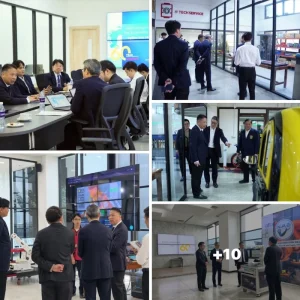
Event: Site Visit and Consultation — World Bank Education Global Practice Team at SiamTech Digital Studios
Guest Delegation: World Bank Education Global Practice Team, led by Dr. Koji Miyamoto, Senior Economist
Host: Siam Technology College (SiamTech) / Siam University, Bangkok
Category: News / World Bank Collaboration, Digital TVET & Skills Development
Overview
Siam University and its affiliated Siam Technology College (SiamTech) welcomed a delegation from the World Bank’s Education Global Practice, led by Dr. Koji Miyamoto, Senior Economist, to a visit of SiamTech’s Digital Studios — a state-of-the-art facility showcasing the integration of digital technology, automotive innovation, and hands-on vocational training. The visit opened a dialogue on potential future collaborations between the World Bank and SiamTech, with both parties looking forward to deepening their partnership.
The meeting covered SiamTech’s approach to technology-driven vocational education — including its partnerships with industry (visible in the S Tech Service automotive workshop and NPS Solutions facilities), its 60-year legacy of technical education, and its vision for a digital-first TVET model that connects students to real-world industry competencies.
About Dr. Koji Miyamoto and the World Bank Education Global Practice
Dr. Koji Miyamoto is a Senior Economist at the World Bank’s Education Global Practice — one of the world’s most influential institutions in education and skills policy. His work spans policy dialogues, programme evaluations, diagnostics, and investment projects across a wide range of topics including:
- 21st-century skills and social and emotional learning (SEL)
- TVET reform in low- and middle-income countries
- Skills assessments and labour market diagnostics
- Foundational skills — literacy, digital competency, and numeracy
Dr. Miyamoto has supported countries across East Asia and the Pacific, Eastern and Central Europe, Africa, the Middle East, and Latin America. He brings direct relevance to Thailand: he was the lead author of the World Bank–Equitable Education Fund (EEF) Adult Skills Assessment in Thailand (ASAT) report (2024), which revealed that 64.7% of Thai youth and working-age adults fall below basic literacy levels and 74.1% lack foundational digital skills — a finding that has significantly shaped Thailand’s national skills policy conversation.
On the significance of foundational skills, Dr. Miyamoto has stated: “These skills are not just prerequisites to undertake any everyday tasks such as ordering food from the internet and teamworking in workplaces; they form the basis for developing advanced abilities like coding and robotics. Moreover, these skills enable people to adapt smoothly to unexpected situations, such as sudden shifts to remote work, health crises, or natural disasters.”
His visit to SiamTech directly connects the global diagnostic work on Thailand’s skills crisis with the on-the-ground institutional capacity being built to address it.
SiamTech’s Digital Studios: What the World Bank Team Saw
The World Bank delegation had the opportunity to explore several key facilities at SiamTech’s campus:
Digital Presentation and Briefing Room
The delegation opened with a formal briefing in SiamTech’s modern meeting studio — where the team reviewed SiamTech’s educational model, its 60-year anniversary milestone, and its approach to “Nurturing [Talent] for Economic [Advancement]” — the theme visible on the presentation screen. This session allowed for direct dialogue between the World Bank economists and SiamTech’s leadership on skills development strategy.
S Tech Service — Automotive Technology Workshop
The delegation toured SiamTech’s S Tech Service facility — a professional-grade automotive technology workshop that serves as both a training environment for students and a real operational service centre. This model — where students learn by doing in an industry-authentic environment — is precisely the kind of work-based learning approach that World Bank TVET research consistently identifies as a critical driver of graduate employability.
Digital Interactive Learning Spaces
The team observed SiamTech’s interactive digital learning environments — including large-format touchscreen displays used for immersive, technology-integrated instruction across vocational disciplines. These facilities represent SiamTech’s commitment to preparing students for digitally-driven industries.
NPS Solutions Partnership Zone
The delegation also visited the NPS Solutions collaborative space — reflecting SiamTech’s active industry partnership model, which connects vocational education directly to private sector technology and solutions providers.
The Stakes: Thailand’s Skills Crisis and the Role of Private TVET
The timing of this World Bank visit is significant. Dr. Miyamoto’s own research has diagnosed a serious skills gap in Thailand — one that, if left unaddressed, threatens the country’s capacity to transition from a middle-income to a high-income economy. The World Bank has estimated that improving foundational skills for Thai youth and adults could increase Thailand’s GDP by up to 20% over the following decade.
Addressing this gap requires systemic change across the full education and training ecosystem. Private vocational institutions like SiamTech — with their industry connections, flexibility, and innovation capacity — play a critical role in this ecosystem that public institutions alone cannot fill.
The World Bank’s visit to SiamTech signals that the global development community sees private TVET providers not as peripheral actors, but as essential partners in Thailand’s human capital transformation. A collaboration between the World Bank’s global expertise and SiamTech’s operational excellence on the ground could generate models, evidence, and interventions that benefit not only SiamTech’s students, but the broader Thai skills development agenda.
Key Takeaways
- The World Bank Education Global Practice’s visit to SiamTech’s Digital Studios reflects growing recognition that private TVET institutions are critical partners in addressing Thailand’s skills crisis — not supplementary actors but systemic ones
- Dr. Koji Miyamoto’s expertise in TVET, 21st-century skills, and adult skills assessment makes him the ideal World Bank interlocutor for a collaboration with SiamTech — connecting global diagnostic insight with institutional capacity for action
- SiamTech’s Digital Studios — integrating automotive workshops, digital learning environments, and industry partnerships — offer a compelling model of what future-ready TVET looks like in practice
- The 60-year anniversary context for SiamTech adds institutional weight to the visit — demonstrating that the institution’s innovation is grounded in decades of proven delivery
- Future collaboration with the World Bank’s Education Global Practice could position SiamTech as a reference institution for TVET innovation in Thailand and the broader East Asia and Pacific region
World Bank Education Global Practice visit to SiamTech Digital Studios, hosted by Siam Technology College and Siam University. For more information on the World Bank’s education work in Thailand, visit [worldbank.org/thailand/education](https://www.worldbank.org/en/country/thailand/brief/education).