
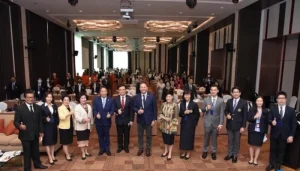
Event: National and International Academic Conference — Innovation and Management for Sustainability
Organising Partners: Siam University Graduate School of Business | Thammasat University School of Global Studies | Singapore University of Social Sciences (SUSS)
Date: Thursday, 1 July 2020 (Two-day conference, on-site and online)
Venue: Eastin Grand Hotel Sathorn, Bangkok
Scale: 198 paper presenters from 19 universities and 16 countries
Category: News / International Academic Conference, Innovation & Sustainability Research
Overview
Siam University’s Graduate School of Business, in partnership with Thammasat University’s School of Global Studies and Singapore University of Social Sciences (SUSS), successfully co-organised the National and International Academic Conference on Innovation and Management for Sustainability — a flagship two-day academic event bringing together distinguished keynote speakers and 198 paper presenters from 19 universities across 16 countries.
The conference — held in hybrid format at the Eastin Grand Hotel Sathorn, Bangkok, with simultaneous online participation — represented a landmark in trilateral academic collaboration between three of Southeast Asia’s leading universities, united by a shared commitment to advancing knowledge on how innovation and management practice can drive sustainable development outcomes.
A Landmark Trilateral Academic Partnership
The partnership at the heart of this conference — between Siam University, Thammasat University, and the Singapore University of Social Sciences — reflects a deliberate strategy of building research and academic communities across borders in Southeast Asia.
Siam University’s Graduate School of Business brought institutional hosting capacity, an established MBA and postgraduate research community, and the professional networks that Dr. Jomphong Mongkhonvanit has cultivated across Thailand’s business, government, and academic sectors.
Thammasat University’s School of Global Studies — one of Thailand’s premier interdisciplinary social science and international affairs schools — contributed a rigorous research orientation and a community of scholars engaged with globalisation, governance, and sustainability from a social science perspective.
Singapore University of Social Sciences (SUSS) added an important regional dimension, extending the conference’s reach across ASEAN and connecting the Thai academic community with Singapore’s internationally networked higher education ecosystem. SUSS’s focus on applied social sciences, lifelong learning, and social enterprise resonates strongly with the conference’s sustainability orientation.
Together, the three institutions assembled an academic community substantial enough to attract 198 paper presenters from 19 universities across 16 countries — a scale that reflects genuine international scholarly interest in the conference’s theme.
Conference Theme: Innovation and Management for Sustainability
The conference’s central theme — Innovation and Management for Sustainability — placed it at the intersection of two of the most important streams in contemporary management and policy scholarship.
Innovation — understood broadly as the application of new ideas, technologies, processes, and models to create value — is widely recognised as the primary driver of productivity growth, competitive advantage, and economic development. Yet innovation alone is insufficient if its outcomes are not aligned with environmental integrity, social equity, and long-term institutional sustainability.
Management for Sustainability encompasses the practices, frameworks, and institutional designs through which organisations — businesses, governments, universities, NGOs — can pursue their missions while actively contributing to, rather than depleting, the environmental and social systems on which all human enterprise depends. This includes sustainability strategy, ESG (Environmental, Social, and Governance) management, circular economy models, green supply chains, social enterprise, and the governance of complex systems under uncertainty.
The conference brought together scholars, researchers, and practitioners working at the frontier of both domains — sharing empirical findings, theoretical frameworks, and practical case studies that advance the field.
Hybrid Format: Adapting to a Challenging Moment
The conference’s hybrid on-site and online format reflected both the logistical realities of its moment — held in July 2020, as the global COVID-19 pandemic continued to constrain international travel — and a forward-looking commitment to accessibility and inclusion. By enabling online participation, the organisers ensured that researchers from all 16 countries represented in the paper presentations could contribute and engage, regardless of travel limitations.
This decision also demonstrated institutional adaptability: rather than postponing or downsizing the event, Siam University’s Graduate School of Business and its partners chose to innovate the conference format — a fitting demonstration of the very theme the conference was convened to explore.
The Scale and Reach of the Conference
The statistics speak to the conference’s genuine international character:
- 198 paper presentations — a substantial body of research covering diverse dimensions of innovation and sustainability management
- 19 universities — representing a broad cross-section of academic institutions from across the region and globally
- 16 countries — spanning Southeast Asia, South Asia, East Asia, and beyond, with presentations reflecting the diversity of innovation and sustainability challenges across different national contexts
The presence of distinguished keynote speakers (captured in the conference photographs addressing a full ballroom) added policy and practitioner depth to what was already a richly interdisciplinary research programme.
Why This Conference Matters for Siam University
For Siam University’s Graduate School of Business, the Innovation and Management for Sustainability Conference is not a one-off event but a reflection of a broader institutional commitment: to produce and convene scholarship that matters — scholarship that connects management theory to real-world sustainability challenges, and that connects Thai and ASEAN researchers to the global academic conversation.
The co-organisation model — with Thammasat and SUSS — also reflects a conviction that the most important academic questions cannot be addressed by any single institution alone. Building research communities across institutions, disciplines, and national borders is essential to generating the kind of knowledge that sustainability challenges require.
Key Takeaways
- The National and International Academic Conference on Innovation and Management for Sustainability demonstrated Siam University’s capacity to co-lead a major international academic event — assembling 198 researchers from 19 universities across 16 countries in a single two-day forum
- The trilateral partnership with Thammasat University and Singapore University of Social Sciences (SUSS) reflects a strategic commitment to regional academic collaboration across ASEAN’s leading research universities
- The hybrid format — pioneered under the constraints of the COVID-19 pandemic — was itself an act of institutional innovation, ensuring global participation despite travel restrictions
- The conference’s theme — innovation and sustainability management — connects directly to the most important challenges facing businesses, governments, and communities in Southeast Asia and globally
- For Thailand’s management research community, events of this scale and international reach are essential for building the peer networks, research standards, and knowledge base that enable Thai scholars to contribute to — and benefit from — the global academic conversation
National and International Academic Conference on Innovation and Management for Sustainability, Thursday 1 July 2020, Eastin Grand Hotel Sathorn, Bangkok. Co-organised by Siam University Graduate School of Business, Thammasat University School of Global Studies, and Singapore University of Social Sciences (SUSS).