
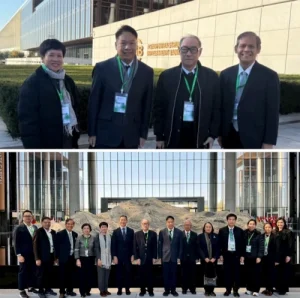
Date: 27 October 2025
Location: Asian Infrastructure Investment Bank (AIIB) Headquarters, Beijing, China
Event: World Bank–Asian Infrastructure Investment Bank Technical Visit and Consultation on Skill Sector Transformation
Representative: Assoc. Prof. Dr. Jomphong Mongkhonvanit, Vice President and Dean, Graduate School of Business, Siam University
Category: News / International Education Finance, Skills Policy & Multilateral Development
Overview
On 27 October 2025, Assoc. Prof. Dr. Jomphong Mongkhonvanit — Vice President and Dean of Siam University’s Graduate School of Business — participated in a high-level Technical Visit and Consultation on Skill Sector Transformation, co-organised by the World Bank and the Asian Infrastructure Investment Bank (AIIB) at AIIB’s headquarters in Beijing, China.
The engagement placed Dr. Jomphong alongside development finance officials and education sector specialists at the intersection of two of the world’s most significant multilateral development institutions — a visit that underscores both the global relevance of skills development as a development priority, and Siam University’s growing engagement with the international policy and finance communities shaping that agenda.
About the World Bank–AIIB Collaboration on Skills
The World Bank and AIIB have developed a substantial collaborative relationship across several development sectors, with skills development increasingly emerging as a shared priority. As Asia and the Pacific face accelerating labour market transformation — driven by AI, automation, demographic shifts, and the green economy transition — both institutions recognise that human capital investment is inseparable from infrastructure investment.
The AIIB, capitalised at USD 100 billion and rated AAA by all major credit rating agencies, is the world’s second-largest multilateral development bank. Since beginning operations in Beijing in 2016, it has grown to 111 approved members and has co-financed over USD 32 billion in projects with peer multilateral development banks, including the World Bank.
The Skill Sector Transformation agenda — the focus of this technical visit — reflects a growing consensus among multilateral development institutions that the skills ecosystem requires not just training investment, but systemic transformation: new qualifications frameworks, stronger industry-education linkages, digital and green skills integration, and institutional reforms that make TVET and higher education genuinely responsive to labour market needs.
Purpose of the Technical Visit
A World Bank–AIIB technical visit of this nature typically serves several interconnected purposes:
- Knowledge exchange between multilateral development bank specialists and national-level education and skills experts
- Consultation on investment priorities — understanding what reforms and interventions in the skills sector can most effectively be financed through multilateral lending instruments
- Country-level intelligence gathering — ensuring that financing strategies reflect on-the-ground realities in member countries such as Thailand
- Policy alignment — connecting national skills reform agendas with the frameworks and standards promoted by major development institutions
- Stakeholder engagement — building relationships between development bank teams and academic, government, and industry representatives who shape skills policy
Dr. Jomphong’s participation — alongside a delegation of Thai and international delegates visible in the group photographs taken at AIIB Headquarters — reflects his recognised standing as a credible interlocutor between Thailand’s education and skills development community and the global development finance architecture.
The Stakes: Skills as Infrastructure
The framing of this visit as a “Skill Sector Transformation” consultation is significant. It signals that multilateral development banks are no longer treating skills investment as a soft social concern, but as a form of human infrastructure with the same strategic importance as roads, ports, and power grids.
AIIB’s investment philosophy — financing infrastructure that is green, technology-enabled, and promotes regional connectivity — is increasingly being extended to human capital. A workforce that lacks the skills to operate, maintain, and innovate around green and digital infrastructure is itself a bottleneck to the development outcomes that physical infrastructure is meant to generate.
For Thailand — a country navigating the twin transitions of digitalisation and decarbonisation, while managing an ageing workforce and persistent skills mismatches — the policy conversations happening at World Bank and AIIB level have direct and immediate national relevance.
Why This Engagement Matters for Siam University
Dr. Jomphong’s presence at AIIB headquarters for a World Bank–AIIB technical consultation on skills represents more than a single visit. It reflects Siam University’s positioning as an institution that:
- Understands and engages with global development finance frameworks — not just as an education provider, but as a contributor to skills policy dialogue at the highest international level
- Bridges academic expertise and multilateral development priorities — connecting cutting-edge scholarship in education, economics, and social sciences with the investment and reform agendas of the world’s largest development banks
- Advocates for Thailand’s skills development interests in international forums — contributing the country-level perspective that multilateral institutions need to design effective interventions
Key Takeaways
- The World Bank–AIIB Technical Visit on Skill Sector Transformation in Beijing signals the growing recognition by multilateral development banks that human capital transformation is infrastructure — and must be financed and governed as such
- Dr. Jomphong Mongkhonvanit’s participation places Siam University at the table of one of the most consequential conversations in Asian development finance — alongside World Bank and AIIB specialists shaping the next generation of skills investment strategies
- AIIB’s AAA-rated, USD 100 billion platform and its deep co-financing relationship with the World Bank give this technical consultation process direct relevance for the scale and type of skills reform investments that member countries — including Thailand — can access
- The consultation represents a natural extension of Dr. Jomphong’s national roles (NCSA Board Director, Cybersecurity Audit Committee Chairman) and international engagements (ADB Forum, UN ESCAP), reinforcing his profile as a trusted voice across government, academia, and international development
- For Thailand’s skills and education ecosystem, engagement with the World Bank–AIIB skills agenda opens pathways to technical assistance, financing, and international best practice that can accelerate national reform at scale
Technical Visit and Consultation on Skill Sector Transformation, co-organised by the World Bank and Asian Infrastructure Investment Bank (AIIB), AIIB Headquarters, Beijing, China, 27 October 2025. For more information on AIIB, visit [aiib.org](https://www.aiib.org).